
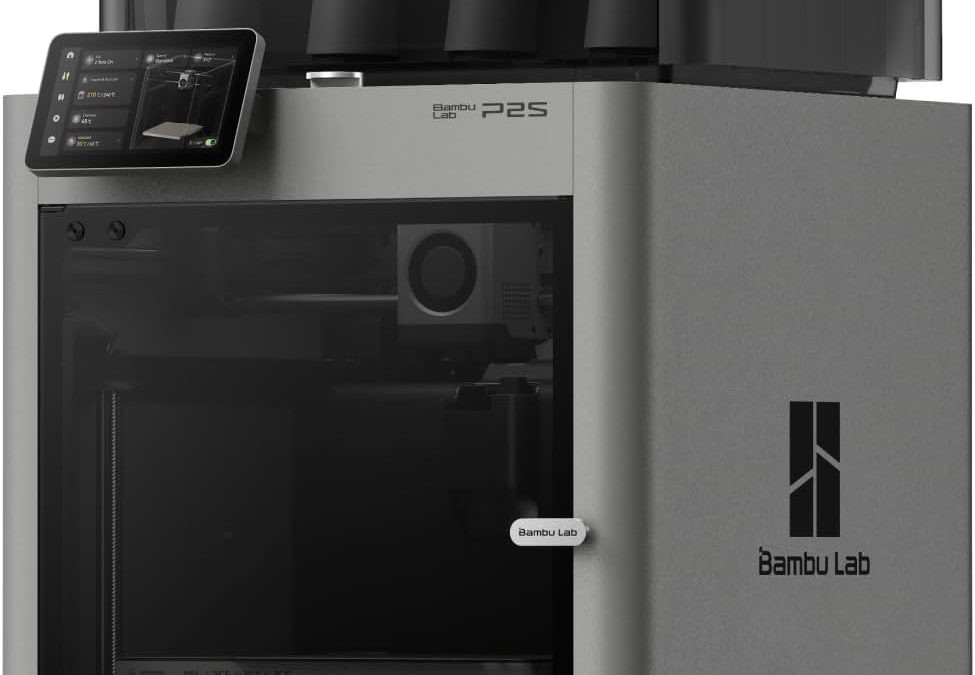
Bambu Lab has been shaking up the 3D printing world for a couple of years now, and their latest release – the Bambu P2S – is generating a lot of buzz, even here in Australia. Whether you’re a seasoned maker or just getting started with FDM printing, this machine promises a lot. But does it actually deliver? Let’s break it down.
What Is the Bambu P2S?
The Bambu P2S is a high-speed CoreXY 3D printer built for people who want professional-grade results without the usual headaches. It’s positioned as an upgrade to the popular P1S, bringing faster speeds, smarter airflow, and better extrusion control to the table. You can grab it as a standalone printer or as the P2S Combo, which bundles it with the AMS 2 Pro for multi-colour and multi-material printing.
Seriously Fast Printing
Let’s start with the headline spec – the P2S prints at up to 600 mm/s. That’s not a marketing number you ignore. For context, many popular printers still top out at 200-300 mm/s. But speed alone means nothing if quality drops, and that’s where the P2S separates itself from the pack.
Thanks to the PMSM Servo Extruder and Active Flowrate Compensation, the printer dynamically adjusts filament flow to maintain clean, accurate results even at high speeds. You get sharp corners, smooth surfaces, and consistent layer lines – the kind of output you’d expect from a machine costing a lot more.
Up and Running in 15 Minutes
One of the biggest pain points with 3D printing has always been setup and calibration. The P2S takes a very different approach. Out of the box, you can be printing in around 15 minutes. Automatic calibration handles the tricky bits, quick-swap nozzles make maintenance easy, and the built-in AI failure detection keeps an eye on your prints so you don’t come back to a spaghetti mess on the build plate.
For Australians who’ve been put off by the learning curve of 3D printing, this is genuinely a game changer. It’s designed to be approachable without dumbing things down for experienced users.
Smart Airflow for Every Filament Type
The P2S features an Adaptive Airflow System that automatically balances cooling and heat retention depending on what you’re printing. Printing PLA with complex overhangs? It’ll blast cool air to keep things crisp. Running engineering-grade materials like ABS or ASA? It maintains a 50°C chamber to prevent warping and delamination.
There’s also a built-in carbon filter, which is a nice touch for anyone printing in a home office or shared workspace – particularly relevant given how many Australians are setting up maker spaces at home.
Multi-Colour Printing with the AMS 2 Pro
If you want to unlock the P2S’s multi-colour potential, you’ll need the Combo version, which includes the AMS 2 Pro. This unit supports up to 20 colours and comes with built-in filament drying at up to 65°C. Keeping your filament dry is especially important in Australia’s more humid coastal regions, where moisture absorption can quietly ruin a print.
It’s worth noting clearly – the standard P2S on its own does not support multi-colour printing. You need the Combo for that. But if multi-colour is on your wish list, the Combo makes it genuinely seamless.
A Massive Ecosystem to Back It Up
Hardware is only part of the story. The P2S plugs into Bambu Lab’s growing ecosystem, including Bambu Studio (their slicing software), the Bambu Handy app for remote monitoring, and access to MakerWorld, which has over one million 3D models ready to download and print. The workflow from finding a model to having it in your hands is genuinely smooth and well thought out.
How Does It Compare to the P1S?
If you’re already familiar with the Bambu P1S, you might be wondering whether it’s worth stepping up to the P2S. The P1S is still an excellent machine – fast, reliable, and well supported. But the P2S pushes things further with its servo extruder, improved airflow system, and higher top speed. If you’re printing frequently or working with a wider range of materials, the P2S upgrade makes a solid case for itself.
If you’re on a tighter budget or just getting started, the P1S remains a brilliant entry point into Bambu’s ecosystem.
So, Is the Bambu P2S Worth It?
For most Australian makers, hobbyists, and small businesses looking for a fast, capable, and easy-to-use FDM printer – yes, absolutely. The combination of speed, print quality, smart features, and a genuinely user-friendly experience makes it one of the most compelling 3D printers on the market right now. The Combo version with the AMS 2 Pro takes things even further if you’re keen to explore multi-colour printing.
It’s not the cheapest option out there, but when you factor in what you’re getting, the value is hard to argue with.